
1917 Russian Revolution
The 1917 Russian Revolution was not, as many people suppose, one well organised event in which Tsar Nicholas II was overthrown and Lenin and the Bolsheviks took power. It was a series of events that took place during 1917, which entailed two separate revolutions in February and October (with a great deal of political wranglings inbetween), and which eventually plunged the country into Civil War before leading to the founding of the Communist State.
Growing Unrest
The first major event of the Russian Revolution was the February Revolution, which was a chaotic affair and the culmination of over a century of civil and military unrest. The causes of this unrest of the common people towards the Tsar and aristocratic landowners are too many and complicated to neatly summarise, but key factors to consider were ongoing resentment at the cruel treatment of peasants by patricians, poor working conditions experienced by city workers in the fledgling industrial economy and a growing sense of political and social awareness of the lower orders in general (democratic ideas were reaching Russia from the West and being touted by political activists). Dissatisfaction of the proletarian lot was further compounded by food shortages and military failures. In 1905 Russia experienced humilating losses in the Russo-Japanese war and, during a demonstration against the war in the same year, Tsarist troops fired upon an unarmed crowd - further dividing Nicholas II from his people. Widespread strikes, riots and the famous mutiny on the Battleship Potemkin ensued.
Such was the climate in 1905 in fact that Tsar Nicholas saw fit, against his will, to cede the people their wishes. In his October Manifesto, Nicholas created Russia's first constitution and the State Duma, an elected parliamentary body. However Nicholas's belief in his divine right to rule Russia meant that he spent much of the following years fighting to undermine or strip the Duma of its powers and to retain as much autocracy as possible. (Modern historians might note that Russian rulers haven't come a long way in the last hundred years!).
When Archduke Franz Ferdinand was assassinated by political activists in Serbia in 1914, the Austro-Hungarian empire declared war on its neighbours. Serbia turned to Russia for help. Tsar Nicholas II saw a chance to galvanise his people against a common enemy, and to atone for the humiliations suffered in the Russo-Japanese war. It didn't quite work out however...
World War I
In many ways Russia's disastrous participation in World War I was the final blow to Tsarist rule. In the very first engagement with the Germans (who had sided with the Austro-Hungarian Empire), the Battle of Tannenberg, the Russian army was comprehensively beaten suffering 120,000 casualties to Germany's 20,000. A continuing series of losses and setbacks meant that Nicholas left St. Petersburg in the autumn of 1915 to take personal control of the army. By this time Russia was sending conscripts and untrained troops to the front, with little or no equipment and fighting in an almost continual retreat. In 1916 morale reached an all time low as the pressure of waging the war fell hardest on prolaterian families, whose sons were being slaughtered at the front and who severe suffered food and fuel shortages at home. The Tsar and the Imperial regime took the blame as civil unrest heated up to boiling point.
The February Revolution (1917)
On 23rd February 1917 the International Women's Day Festival in St. Petersburg turned into a city-wide demonstration, as exasperated women workers left factories to protest against food shortages. Men soon joined them, and on the following day - encouraged by political and social activists - the crowds had swelled and virtually every industry, shop and enterprise had ceased to function as almost the entire populace went on strike.
Nicholas ordered the police and military to intervene, however the military was no longer loyal to the Tsar and many mutinied or joined the people in demonstrations. Fights broke out and the whole city was in chaos. On October 28th over 80,000 troops mutinied from the army and looting and rioting was widespread.
Faced with this untenable situation Tsar Nicholas abdicated his throne, handing power to his brother Michael. However Michael would not accept leadership unless he was elected by the Duma. He resigned the following day, leaving Russia without a head of state.
The Provisional Government
After the abdication of the Romanovs a Provisional Government was quickly formed by leading members of the Duma and recognised internationally as Russia's legal government. It was to rule Russia until elections could be held. However it's power was by no means absolute or stable. The more radical Petrograd Soviet organisation was a trade union of workers and soldiers that wielded enormous influence. It favoured full-scale Socialism over more moderate democratic reforms generally favoured by members of the Provisional Government.
After centuries of Imperial rule Russia was consumed with political fervour, but the many different factions, all touting different ideas, meant that political stability was still a long way off directly after February Revolution.
Lenin Returns to Russia
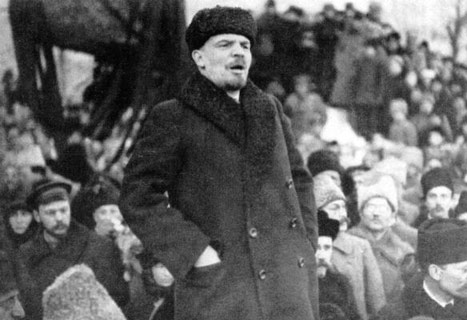
One person keen to take advantage of the chaotic state of affairs in St. Petersburg was Vladimir Ilyich Ulyanov - aka Lenin. Lenin had spent most of the 20th Century travelling and working and campaigning in Europe - partly out of fear for his own safety, as he was known Socialist and enemy of the Tsarist regime. However with the Tsar under arrest and Russian politics in chaos, Lenin saw the opportunity to lead his party, the Bolsheviks, to power. From his home in Switzerland he negotiated a return to Russia with the help of German authorities. (As a proponent of withdrawing Russia from the Great War, the Germans were willing to facilitate Lenin's passage back via a 'sealed train'.)
Lenin's return in April of 1917 was greeted by the Russian populace, as well as by many leading political figures, with great rapture and applause. However, far from uniting the fractious parties, he immediately condemned the policies and ideologies of both the Provisional Government and the Petrograd Soviet. In his April Theses, published in the Bolshevik newspaper Pravda, he advocated non-co-operation with the liberals (ie. non-hardline Communists) and an immediate end to the war.
At first his uncompromising stance served to isolate Lenin and the Bolsheviks, however with powerful slogans like 'Peace, land and bread,' Lenin begin to win the hearts of the Russian people - who were increasingly unable to stomach war and poverty.
Summer of 1917
During the summer of 1917 Lenin made several attempts to invoke another revolution the likes of which had taken place in February, with the aim of overthrowing the Provisional Government. When the Machine Gun Regiment refused to leave Petrograd (as St. Petersburg was then known) for the frontline Lenin sought to manoeuvre them instead into making a putsch. However Kerensky, arguably the most important figure of the time - a member of both the Provisional Government and Petrograd Soviet - adeptly thwarted the coup. Experienced troops arrived in the city to quell any dissidents and the Bolsheviks were accused of being in collusion with the Germans. Many were arrested whilst Lenin escaped to Finland.
Despite this PR disaster Lenin continued plotting and scheming. Meanwhile Kerensky suffered his own political setbacks and even had to appeal to the Bolsheviks for military aid when he feared his Minister of War, Kornilov, was aiming for a military dictatorship. By autumn the Bolsheviks were climbing into the ascendency, winning majority votes within the Petrograd and Moscow Soviets. Leon Trotsky was elected as president of the former.
The October Revolution
(Nb. By the Julian Calendar used in Russia at the time, the revolution took part in November 1917, and is therefore often referred to as the November Revolution)
With Russian politics still in a state of constant flux Lenin realised that now was the time to capitalise on his party's popularity. He planned a coup d'etat that would overthrow the increasingly ineffective Provisional Government and replace them with the Bolsheviks. On October 10th he held a famous meeting with twelve party leaders, and tried to persuade them that a revolution was required. Despite receiving the backing of only 10 of them plotting went ahead.
October 24th was the date decided upon, and on that day troops loyal to the Bolsheviks took up crucial positions in the city, such as the main telephone and telegraph offices, banks, railroad stations, post offices, and major bridges. Guards commissioned by the Provisional Government, who had got wind of the plot, fled or surrendered without a fight. By the 25th October every key building in St. Petersburg was under Bolshevik control, except the Winter Palace where Kerensky and the other Ministers were holed up with a small guard.
At 0900 of that day Kerensky fled the Palace by car, never to return to Russia. On the 26th the Palace was taken with barely a shot fired, and Lenin's October Revolution had been achieved with the bare minimum of drama or bloodshed.
Aftermath and Consequences
Despite being allowed to seize power so easily Lenin soon discovered that his support was far from absolute. His Peace Policy with the Germans was particularly unpopular as it ceded large amounts of Russian territory. Shortly after the October Revolution, the Russian Civil War broke out between the 'Reds' (Communists) and the 'Whites' (Nationalists, Conservatives, Imperialists and other anti-Bolshevik groups). After a bloody four year struggle Lenin and the Reds won, establishing the Soviet Union in 1922, at an estimated cost of 15 million lives and billions of roubles. In 1923 Lenin died and Stalin took over the Communist Party, which continued to rule Russia until 1991 when the USSR was dissolved.
Comments
Bro I need the citations for this website for a school research project so I don’t plagiarize. Can anyone be a homie and give it or where to look
Replywhat are you talking about communism sucks
ReplyYou know communism doesn't seem so bad afterall. Might support uncle joe and bernie to form socialism and communism all over again :)
ReplyEvaluated the Russian revolution as a challenge to aristocracy
Replywhat happened to the rich Russians during the revolution
Replythx alot sarcassem
ReplyWhat was life like for the common people after the Russian Revolution
ReplyRead "The Gulag Archipelago". It's basically the reality of life in Russia post 1917.
Replyمن هو الذي فاز في الصوره الروسيه
ReplyTHANKS!!! :)
ReplyWhat countries were involved in the fighting at the "front" in Feb. 1917? Where was the front, and how was Turkey involved?
Replyi hope your having a great day mate
ReplyWow this helped me a lot thanks bro for helping me get that A plus
ReplyWhen did the revolution end?!?!?!
Replylit
Replyi wanted to know how life was hard in the Russian Revolution not this
Replyit says 8 min read but it took me 3 hours
ReplyFunny
ReplyMe too
ReplyOslo 1929,men vi har jo allerede heroinknekken som møter de som kommer sjøvveien
ReplyHAHAHAHAHAHAHAHAHAHAHAHAHAHAHAHAHAHAHAHAHAHAHAHAHAHAHAHAHAHAHAHAHAHAHAHAHAHAHAHAHAHAHAHAHAHAHAHAHAHAHAHAHAHAHAHAHAHAHAHAHAHAHAHAHAHAHAHAHAHAHAHAHAHAHAHAHAHAHAHAHAHAHAHAHAHAHAHAHAHAHAHAHAHAHAHAHAHAHAHAHAHAHAHAHAHAHAHAHAHAHAHAHAHAHAHAHAHAHAHAHAHAHAHAHAHAHAHAHAHAHAHAHAHAHAHAHAHAHAHAHAHAHAHAHAHAHAHAHAHAHAHAHAHAHAHAHAHAHAHAHAHAHAHAHAHAHAHAHAHAHAHAHAHAHAHAHAHAHAHAHAHAHAHAHAHAHAHAHAHAHAHAHAHAHAHAHAHAHAHAHAHAHAHAHAHAHAHAHAHAHAHAHAHAHAHAHAHAHAHAHAHAHAHAHAHAHAHAHAHAHAHAHAHAHAHAHAHAHAHAHAHAHAHAHAHAHAHAHAHAHAHAHAHAHAHAHAHAHAHAHAHAHAHAHAHAHAHAHAHAHAHAHAHAHAHAHAHAHAHAHAHAHAHAHAHAHAHAHAHAHAHAHAHAHAHAHAHAHAHAHAHAHAHAHAHAHAHAHAHAHAHAHAHAHAHAHAHAHAHAHAHAHAHAHAHAHAHAHAHAHAHAHAHAHAHAHAHAHAHAHAHAHAHAHAHAHAHAHAHAHAHAHAHAHAHAHAHAHAHAHAHAHAHAHAHAHAHAHAHAHAHAHAHAHAHAHAHAHAHAHAHAHAHAHAHAHAHAHAHAHAHAHAHAHAHAHAHAHAHAHAHAHAHAHAHAHAHAHAHAHAHAHAHAHAHAHAHAHAHAHAHAHAHAHAHAHAHAHAHAHAHAHAHAHAHAHAHAHAHAHAHAHAHAHAHAHAHAHAHAHAHAHAHAHAHAHAHAHAHAHAHAHAHAHAHAHAHAHAHAHAHAHAHAHAHAHAHAHAHAHAHAHAHAHAHAHAHAHAHAHAHAHAHAHAHAHAHAHAHAHAHAHAHAHAHAHAHAHAHAHAHAHAHAHAHAHAHAHAHAHAHAHAHAHAHAHAHAHAHAHAHAHAHAHAHAHAHAHAHAHAHAHAHAHAHAHAHAHAHAHAHAHAHAHAHAHAHAHAHAHAHAHAHAHAHAHAHAHAHAHAHAHAHAHAHAHAHAHAHAHAHAHAHAHAHAHAHAHAHAHAHAHAHAHAHAHAHAHAHAHAHAHAHAHAHAHAHAHAHAHAHAHAHAHAHAHAHAHAHAHAHAHAHAHAHAHAHAHAHAHAHAHAHAHAHAHAHAHAHAHAHAHAHAHAHAHAHAHAHAHAHAHAHAHAHAHAHAHAHAHAHAHAHAHAHAHAHAHAHAHAHAHAHAHAHAHAHAHAHAHAHAHAHAHAHAHAHAHAHAHAHAHAHAHAHAHAHAHAHAHAHAHAHAHAHAHAHAHAHAHAHAHAHAHAHAHAHAHAHAHAHAHAHAHAHAHAHAHAHAHAHAHAHAHAHAHAHAHAHAHAHAHAHAHAHAHAHAHAHAHAHAHAHAHAHAHAHAHAHAHAHAHAHAHAHAHAHAHAHAHAHAHAHAHAHAHAHAHAHAHAHAHAHAHAHAHAHAHAHAHAHAHAHAHAHAHAHAHAHAHAHAHAHAHAHAHAHAHAHAHAHAHAHAHAHAHAHAHAHAHAHAHAHAHAHAHAHAHAHAHAHAHAHAHAHAHAHAHAHAHAHAHAHAHAHAHAHAHAHAHAHAHAHAHAHAHAHAHAHAHAHAHAHAHAHAHAHAHAHAHAHAHAHAHAHAHAHAHAHAHAHAHAHAHAHAHAHAHAHAHAHAHAHAHAHAHAHAHAHAHAHAHAHAHAHAHAHAHAHAHAHAHAHAHAHAHAHAHAHAHAHAHAHAHAHAHAHAHAHAHAHAHAHAHAHAHAHAHAHAHAHAHAHAHAHAHAHAHAHAHAHAHAHAHAHAHAHAHAHAHAHAHAHAHAHAHAHAHAHAHAHAHAHAHAHAHAHAHAHAHAHAHAHAHAHAHAHAHAHAHAHAHAHAHAHAHAHAHAHAHAHAHAHAHAHAHAHAHAHAHAHAHAHAHAHAHAHAHAHAHAHAHAHAHAHAHAHAHAHAHAHAHAHAHAHAHAHAHAHAHAHAHAHAHAHAHAHAHAHAHAHAHAHAHAHAHAHAHAHAHAHAHAHAHAHAHAHAHAHAHAHAHAHAHAHAHAHAHAHAHAHAHAHAHAHAHAHAHAHAHA
ReplyThanks for helping me with my homework!!!!!!!!!!!!!!!
ReplyWhat happened to Europe during the Russian Revolution?
Replywhat happened to Russia after the revolution?
ReplyI need to cite this article. Does anyone know how or where to get the information from?
ReplyEvaluate Russian revolution as a challenge to aristocracy? Please help me answer this, need it for a project in school. Thank you.
Replyread this article. The Russian revolution is literally a group of people rising up and challenging the aristocracy, defeating them and taking over. all you need to do is actually read what happened and then write about it. just try. you clearly have not tried at all.
ReplyU are right
Replyi agree with you this is not enough information
Replymany thank b0ss
ReplyOmg best article since i'm doing a history project :) YAY.
ReplyA most informative article
ReplyWOW!! Very cool information! I knew this would happen after I ran away. ( p.s. I was not killed. I ran before they could kill me.) I had already warned the Tsar of what would happened if he attempted to kill me.
Replywould you plz tell me that what do you mean by saying ,"I knew this would happen after I ran away. ( p.s. I was not killed. I ran before they could kill me.) I had already warned the Tsar of what would happened if he attempted to kill me.". please do tell me what do you mean by this .
Replywow this is great . i have learnt nothing. Thanks
ReplyWow this is good!!!!!!!!!!!!!!!!!
Replyim working on a project and this was so much help!
ReplyI read a huge book about leningrad. did you know that there were actual cannibals?
Replythis actually had the numbers of stuff!
Replyi think this is interesting
Replyseriously,i sent you an email
Reply???
ReplyWhy dose Russia have to be so complicated?
Replywho were the group of people who didnt want the revolution?
Replythe tsars and something else i think
ReplyThis is pretty Bazinga!
Replythanks helped a lot
ReplyIt helps
ReplyA i was kid in if every body’s power hungry were would we be"?
ReplyWell helped a lot. I am working on different sides of revolution as opposed and revolutionary groups. In this assessment we need to see different perspectives of people as Russians and other countries.
ReplyMankind's rule will always be a failure .Only God's Kingdom under the Mighty King Jesus Christ will true peace,justice and prosperity for all be achieved.
ReplyAfter a bloody four year struggle Lenin and the Reds won, establishing the Soviet Union in 1922, at an estimated cost of 15 million lives and billions of roubles. In 1923 Lenin died and Stalin took over the Communist Party, which continued to rule Russia until 1991 when the USSR was dissolved.
Replyit seems that no blood shed happened never before revolution of russia in human history, it was the history of exploitation over the masses by the well up people of society in the name of religion in the name of caste etc it was the revolution of Russia by VI Lenin show the actual role of mankind and established the rights of the commoner, it has been failed long after that is other story definitely it should be reviewed properly on the light of November revolution
Replywe could of just read it from the damn artice
ReplyThis helped so much with my essay!!!!!
ReplySoo much help. I have an assessment on the Russian Revolution and this helped so much. Thank you!
ReplyThis helped me a lot with my presentation on the Russian revolution.
ReplyThis seems to be misleading
ReplyExam coming up.....helped so much
Replywow.......
ReplyNeeded this for holiday homework
ReplyLiberia
ReplyIs there a year his was written/ who wrote it
ReplyPretty dark fam
ReplyPardon me are you Aaron Burr sir?
ReplyThat depends, who's asking?
ReplyOh well sure, sir! I'm Alexander Hamilton I'm at your service, sir, I have been looking for you
ReplyI'm getting nervous
ReplyATTENTION YOU ALL: I am agent gift the Illuminati official agent,i am from Nigeria and I join Illuminati in US, I have been give the alternative to expose the Illuminati to the universe: that Illuminati is real when you meet a rightful agent like me - John Benson. I have been an agent to this brotherhood more than eight years now and I am still a member and agent. Don't be afraid to contact us if you are willing to join this fraternity, we welcome anybody. If you want to join us, add us on Whatsapp +2348135429218. Because the Illuminati use Whatsapp.
ReplyThe illuminate started as a group of scientists in ancient Rome who had to hide from witch hunters naming themselves the illuminate as it means "the Enlightened Ones"
ReplyAlexander, it was not Ancient Rome, it was in the middle ages. (There wasn't the concept of 'witches' in Ancient Rome... The fact that you're from the US is starting to show.
ReplySo bush did 911?
ReplyLMAO!
Replythank you so much this helped me a lot xx
ReplyCotton balls.
ReplyThis was a good article but i just wish i could lose my virginity by the time i turn 50....which is tomorrow....
ReplyVery bad
ReplySUPER informing. I liked it!
ReplyGay
ReplyThanks for the help i owe you one
Replythe taliban captured my town
Replyit has great information
ReplyNo..just...NOOOOOOOOOOOOOOOOOOOO!
Replyít hєlpєd mє wíth mч híѕtσrч єѕѕαч hσmє wσrk
Reply2 in the top and 2 in the saddle, I drank it all down but it tasted like wood.
Replyit had too many big words that were hard to understand and it should be a little shorter so it is a easier quick read because I need some of this information and there is too much to read
ReplySaved my life, helped me with my history homework...if it wasn't for this website I would've been in loads of trouble at school:)
Replywho was supposed to take over for Lenin? who did and why
ReplyYour BUTT!
ReplyThanks! helped me in my over-due history essay, but too brief.
ReplyWhat's the difference between the two revolutions??
Replyone is stupid and the other one is stupider
Replygood and impressive work
ReplyVery much interested in Russian history
ReplyI think that this is very well detailed and articulate article and explanation of the Russian Revolution 1917.
ReplyESSAY GOT 20/20 !!!!!!!
ReplyNO ONE CARES!!!!!!
ReplyHelped the world to understand the history in other countries.
Replythx
ReplyVery helpful :-)
Reply